Q. What do you mean by "high speed Internet"?
A. We mean the ability to use the Internet for e-mail and the World Wide Web without using a telephone line to make the connection. Information goes to and from the Internet in brief electronic signals called "bits." A dialup connection, using the phone to send and receive information, transmits about 52,000 bits per second (52Kbps), if you're lucky. A high speed connection is at least five times faster (256Kbps), often much more.
Q. What difference does it make how fast the connection is?
A. There are many things that can't be done on a dialup connection. For example, it's too slow for online college courses, or downloading photographs and large documents. Students who have only dialup for homework assignments are at a great disadvantage because Internet research takes much longer to do. Some Warwick people could work at home at least part of the time and others could set up new businesses if they had a high speed Internet connection. You can't watch video or play online games on a dialup connection.
Q. So what's the plan?
A. The selectboard is negotiating for space on the Mt. Grace fire tower and the cell tower on the Gale property (owned by American Tower) on which to put equipment to connect to the Internet. At first, we'll use the satellite signal that currently supplies the library with Internet access. If town meeting approves, Phase I of the project will purchase and install base station radios on the two towers, and subscriber radios to serve the town hall, police and fire stations, the police cruiser, and the highway department. Cost of equipment and installation will be $17,500. In addition, we will buy $10,000 worth of gravel to satisfy our part of the bargain with the state in which we supply materials to repair the access road to the Mt. Grace tower in case of a washout. Any repair work will be done by the state; our part is the gravel.
We don't yet know which houses the signal will be able to reach. Anyone who can see either of the towers when the leaves are on the trees can surely get it, but others will also be able to. The first thing we'll do after we get the signal set up is to use a laptop in the police cruiser, as it is driven around town in the regular course of police work, to determine just where the signal is strong and where additional equipment is needed to make it strong enough for household use. With that information, we'll be able to add a few private households as testers of the system. By the time Phase I is complete, we'll know where we need to boost the signal to get to as many homes as possible.
In Phase II we'll replace the satellite Internet connection with a real broadband connection. The Broadband Committee has identified two possible sources to bring the Internet to town wirelessly. To do this, we'll need another $11,500 worth of equipment, for a total of $39,000. We're asking for $40,000 so we don't have to come back to you for more money if prices go up. We have a backup plan to bring the signal in with a T1 data line, like the one that supplied the Board of Health under a one-year Department of Homeland Security grant in 2006.
At this point we'll be ready to involve more households as testers. We'll be looking for 10-20 people who are willing to invest about $500 to buy their own receiving equipment, giving us feedback as they use the system. These will be people with the technical skills and patience to help work out the kinks. We'll need these testers to contribute to the increased cost of the faster connection to the Internet in Phase II. A member of the Broadband Committee who has the technical knowledge has offered to help with installations and provide some support to the testers. The vendor who sells us the equipment on the towers will support that equipment and act as a backup to our volunteer technician.
Q. I'm not technical, but I'm interested. Where do I come in?
A. You get into the act in Phase III, which we're hoping (but not promising) will start in about a year. We expect at that point to contract with an Internet service vendor. End user equipment will be part of the monthly price and the vendor will provide the professional technical support and front office support customers expect in a business relationship. We won't just walk away, though, for two reasons: access to the Mt. Grace tower will be in the town's name, and not available to a commercial vendor. Besides, the town's $40,000 investment will have done what it would take a vendor multiples of that amount to do, by scoping out the area and seeing where additional equipment is needed. We expect our contract with the vendor will include some form of payment to the town to help us, at a minimum, to recoup our initial expense.
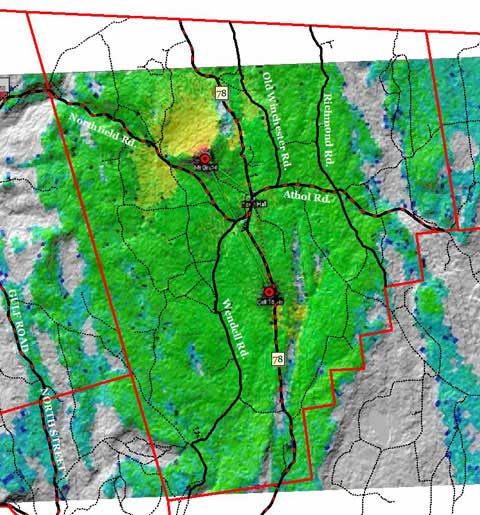
Depicted is the predicted coverage map of the Warwick Broadband project. Areas colored red, green, or yellow predict service. Data for the blank area in the north was not included when our consultant compiled the map. That does not mean the system will not reach this "blank" area. The system will not reach through land mass and that is why the area near Clubhouse is not served. The Motorola canopy radios have a range of more than 20 miles.